What Are Your Values?
How knowing your own values gives you a clear inner compass for making decisions, navigating challenges, and living a more authentic and purposeful life.

You can listen or download this week’s post.
SUMMARY
For this week’s essay, I’m sharing exercises from The WHOLE Companion Workbook focused on values, authenticity, and self-awareness. Designed to move beyond inspiration into practical transformation, these exercises encourage you to define your guiding principles, understand how you see yourself, and align your life with what truly matters in order to live more purposefully and authentically.
ARTICLE
Over lunch with a very good friend who is a public relations executive we discussed my book WHOLE and the release of a revised edition. She said “Even with a revised edition, it’s a challenge to promote a book that essentially is more than ten years old. But you know what? You should do a workbook to go with it.” DING! A bell when off in my head and I knew she was right.
I have always found it challenging to read a spiritual or self-awareness book and follow up by digging deeper and putting the ideas and concepts into practice. WHOLE has gotten amazing reviews on Amazon, but who knew what readers would or could do once they put the book down. And so, a three-year journey began to write The WHOLE Companion Workbook. When the draft was finished, I sent an email out to clients and 16 of them joined together as a focus group to test out the exercises in the workbook that correspond to each chapter in WHOLE and give great feedback. I will be forever grateful to them all and they are acknowledged in the book.
This is the 42nd consecutive week of posting Substack essays. As I mentioned in a previous post from time to time I will post chapters from WHOLE. This week, I have decided to share the exercises from the workbook that correspond to Chapter 2, titled VALUES, where you will get to list your values and more. I have heard from readers that the WHOLE Companion Workbook while challenging is life changing. I hope that you find this week’s post/exercises useful, inspiring and personally enlightening. You’ll need a pen and paper or your journal.
Exercise 1. LIST YOUR VALUES
Have you ever stopped to think about your values? Values help not only to determine the life that you want but also the extent to which you are able to “live with yourself.” Core values are (or if you change them become) the guiding principles of your life. They are the foundation for the life you create and can be the filters for everything you do and how you choose to show up in the world.
Years ago, someone told me that when you choose to partner with others, when you choose to hire others, gather a team to accomplish something—or even bigger—change the world, that one of the keys to success will be your shared values. I’ve never forgotten that. Your values are always a determiner of successful personal relationships, even your primary relationship. Values are also the filters to be used for making choices and decisions.
It does seem, however, that values are never really discussed. They certainly weren’t talked about in school. We sort of just think we know we have them, and when asked, we can come up with a few. This is your opportunity to discover and document your values. You can list between six and ten. You may complete a few drafts before you settle on your final list. When the list is finished, place it somewhere where you will see it every day.
There are a few examples below, and here are a few hints for discovery:
1. (Note: A previous exercise asked readers to make a list of the people they admire so you might want to do that first.) Remember the list of people you admire? You actually share values with them, so see if you can discern what those are.
2. Think of the aspects of your own personality and the way you are in the world. An example might be the way you respond with compassion when those around you are challenged. Or how you respond with integrity if you are given to much change at the register.
Examples of Values:
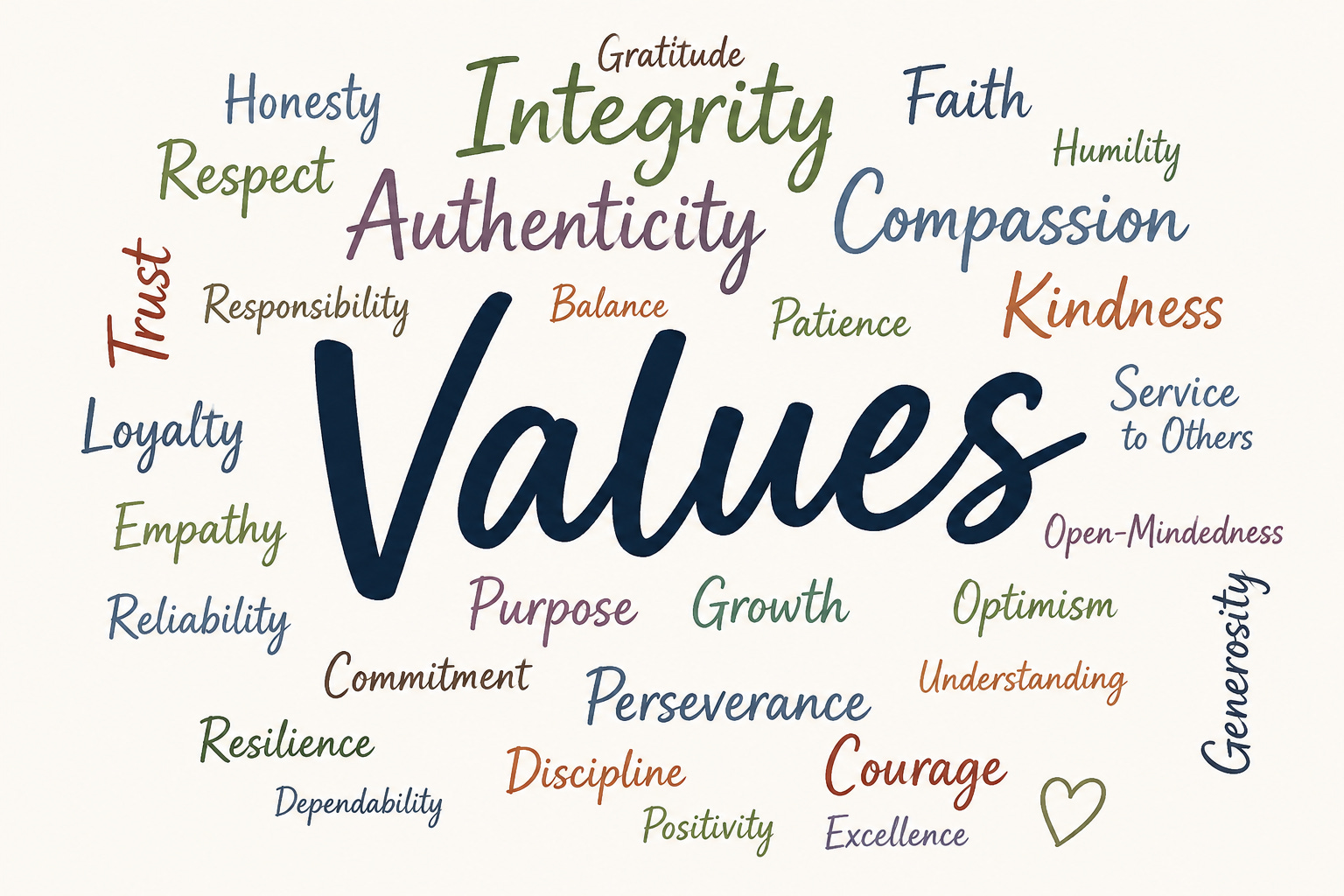
Integrity. Integrity means being true to myself and true to my word. It means that I keep my word to myself as well as others. Integrity means I can be trusted to do what I consider to be the right thing even when no one knows I am doing it.
Faith. I have a deep faith in the presence and operation of The Divine in my life. I also have faith in myself relative to my ability to learn, grow, achieve and contribute.
Some other examples may be Kindness, Dependability, Authenticity, Perseverance, Open-Mindedness, Loyalty, Adventurousness, Optimism and Service to Others.
Now make your list and define what each value means to you. Put the list in a place where you can see it from time to time. Mine is in the front of each journal.
Exercise 2. QUESTIONS
The following questions provide the opportunity for you to objectively see your values at work. Write out your answers.
1. Where or how do you feel that you have made a difference in the lives of others?
2. How do you see yourself?
From the book WHOLE (Chapter 2: Values) “Your truth, how you see yourself, will be how the world sees you, and there will be no need to prove or convince the world of your value. People see the truth with their hearts. There is no need for them to be sold on it.”
How do you see yourself? Often people may alter the story of who they are or how they want to be perceived according to what they think other people may want. Sometimes, for many reasons, this can be far afield from your true self. You may present yourself through “filters” which may temporarily satisfy what you believe the expectations of others may be, but you will find it much easier to be your authentic self. So, in the absence of worry about what others may think, how do you see yourself? An example might be “I see myself as an intelligent, respectful, and compassionate problem solver who is able to connect authentically and inspire others.
The final exercise in most chapters of the workbook is a “Real-World Application” which provides the opportunity to put what you have discovered and learned to work. Here then is this chapter’s real-world application.
Exercise 3. Real-World Application. Don’t Sell.
The next time you find yourself in circumstances where you feel the need to “sell” yourself, shift into stillness and listening mode. Rather than talk about yourself, shift the conversation and make it about the other person. If the other person is “present” they will ask about you. Then you can answer their questions from a centered place, knowing you really have nothing to prove, but only to be. If the other person does not ask about you, then you will know it is likely they will not be available to the quality of relationship that reflects your values. This does not make them a bad person; it is simply where they are in their lives, and chances are they are working very hard to prove their value and their worth.
Where Can You Get WHOLE and The WHOLE Companion Workbook?
If you’re interested in more exercises and to “reconcile your past, embrace the present and create your future” “The WHOLE Companion Workbook” is available for purchase at LULU and AMAZON. It can be used as a stand-alone workbook or in conjunction with the book WHOLE which is available at LULU and AMAZON and many other sellers. The audiobook of WHOLE read by the author is available on most audiobook platforms including AUDIBLE.
ABOUT WHOLE LifeWorks™
The purpose of WHOLE LifeWorks™ is to empower you to reconcile your past, embrace your present and create your future by providing insight, information and inspiration as well as practical tools for daily living and personal growth.
This includes books, articles, social media and community groups, special events, the WHOLE LifeWorks™ Coaching Program, personal readings and the forthcoming WHOLE Companion Workbook Roundtables. For more information or to purchase the books WHOLE or The Whole Companion Workbook visit WHOLE LifeWorks™.